







Small Businesses Are Paying More for Health Insurance.
The 2026 Numbers Show Why It's Time to Rethink Your Benefits.
The latest KFF Employer Health Benefits Survey shows a growing affordability gap for small businesses and their employees. Here’s what small and medium sized business owners, CFOs, and HR leaders need to know.
2026 employer health insurance costs are up again. That’s not news to anyone running a business.
But the newly released 2026 KFF Employer Health Benefits Survey tells a particularly troubling truth for small and mid-sized businesses: employees at smaller companies are paying significantly more for family health insurance than their counterparts at larger organizations. And they’re often facing higher deductibles, too.
If you own a business, you’re already watching margins, fighting to hire good people and trying to keep benefits worth having. So here’s the real question: is your healthcare money actually buying you more, or are you just paying more?
In this article:
- 2026 Employer Health Insurance Costs: What Every Small Business Should Know
- Your Employees May Be Paying $2,847 More for Family Coverage
- A Lower Renewal Increase Doesn’t Necessarily Mean You’re Saving Money
- What Happens When Small Businesses Take a Different Approach?
- Five Questions Every Business Owner Should Ask Before Their Next Renewal
- It’s Time to Expect More From Your Healthcare Benefits
2026 Employer Health Insurance Costs: What Every Small Business Should Know
According to KFF’s annual survey of U.S. employers:
- $28,303: Average annual premium for employer-sponsored family health coverage, up 5% from 2025.
- $9,687: Average annual employee contribution toward family coverage at smaller businesses, compared with $6,840 at larger companies.
- 37%: Average share of family premiums paid by employees at smaller firms, compared with 25% at larger firms.
- $2,624: Average single-coverage deductible for covered workers with deductibles at smaller businesses, compared with $1,772 at larger companies.
- 55%: Share of covered workers at smaller firms with a single-coverage deductible of $2,000 or more, compared with 33% at larger firms.
KFF defines smaller businesses as those with 10 to 199 employees.
These insurance statistics have real implications for recruiting, retention, employee financial well-being, and business profitability.
Your Employees May Be Paying $2,847 More for Family Coverage
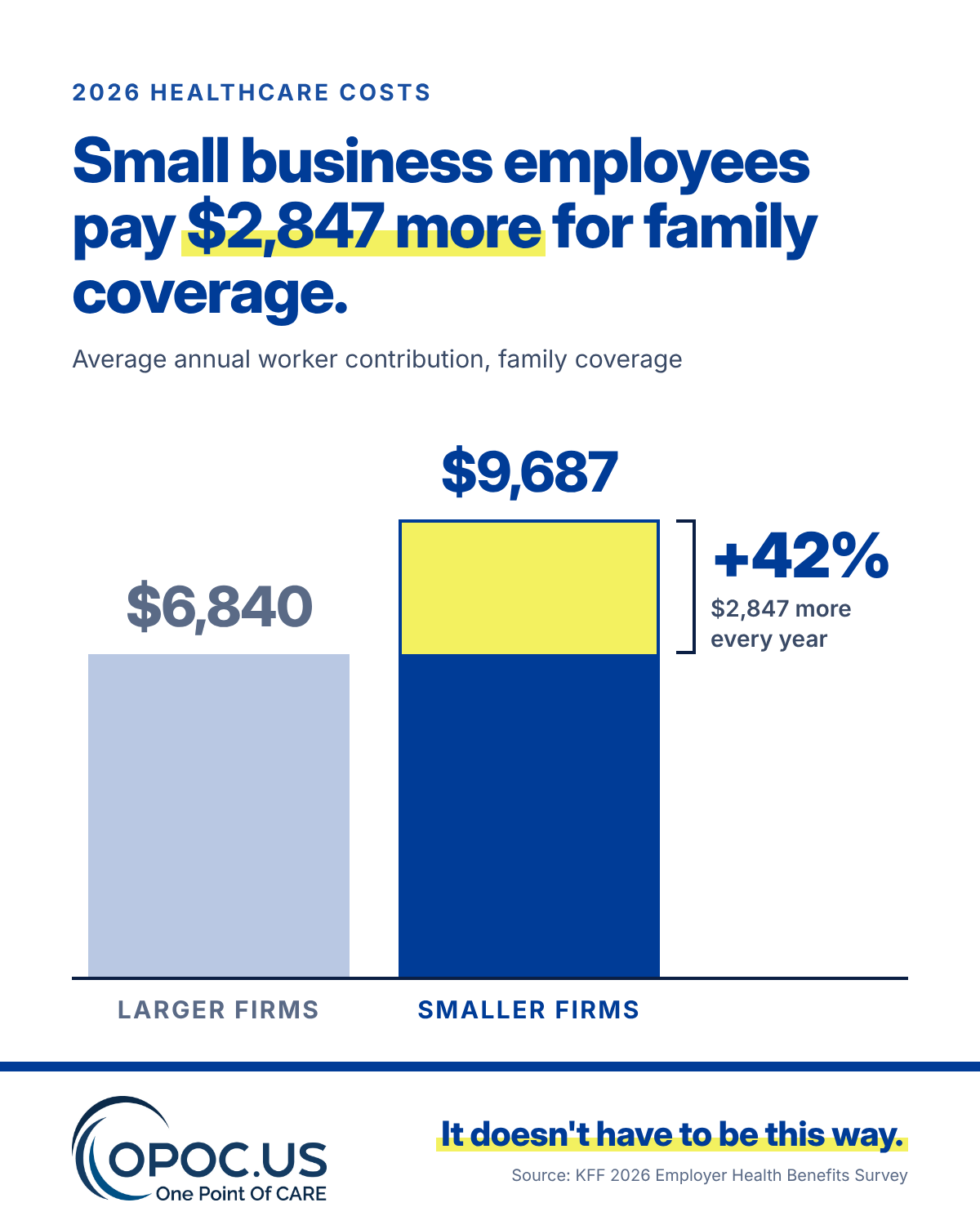
One of the most striking findings in the KFF report is the difference in what employees contribute toward family health insurance.
At smaller businesses, covered workers contribute an average of $9,687 annually. At larger companies, the average is $6,840.
That’s a $2,847 difference every year.
For an employee with a family on their benefits, that’s nearly $240 more per month going toward health insurance premiums.
For a small business trying to attract and retain skilled employees, it’s a competitive challenge.
And for business owners who care deeply about their teams, it’s frustrating. You’re investing significant dollars in healthcare benefits, yet employees may still feel that coverage is too expensive.
The problem may be how your benefits are structured and managed, not necessarily how much you are spending.
Higher Deductibles Make the Problem Worse
Premiums are only part of the picture.
The KFF survey found that 55% of covered employees that work at smaller businesses have a general annual deductible of $2,000 or more for single coverage. That compares with just 33% at larger companies.
Higher deductibles can force employees to face significant expenses before their health plans begin covering many services. So then employees put off appointments, questioning whether they can afford treatment, or struggling to understand what their insurance actually covers. And when employees have questions about claims, prescriptions, or medical bills, those questions often land on the desk of an already overextended HR manager.
A healthcare plan shouldn’t be a financial burden for employees or an administrative burden for the business.
A Lower Renewal Increase Doesn’t Necessarily Mean You’re Saving Money
The national average premium increase was 5% in 2026, according to KFF. But that doesn’t mean every employer experienced a 5% renewal.
Individual businesses can face different increases depending on their plan, claims experience, market, and other factors. KFF notes that early forecasts for 2027 indicate further cost increases, potentially approaching double digits.
Imagine your business receives an 18% renewal increase. After negotiations, that increase comes down to 12%. It might feel like a win. But your healthcare expenses are still increasing 12%.
For a company spending $500,000 annually on healthcare, that’s another $60,000 in expenses.
The important question is whether your healthcare plan is designed to control costs in the first place. That requires looking beyond premiums to understand what you’re paying for, how employees actually use their benefits, and where opportunities exist to eliminate unnecessary spending.
There’s a Better Option Than Passing Costs to Employees
When premiums rise, most employers do one of two things. They absorb it, or they make employees pay more. This year, 44% of large employers chose the second option. Both approaches treat the price as fixed and it usually isn’t.
Here’s where the savings tend to hide:
- Costs you can’t see. Only 14% of employers ‘strongly agree’ they know what their plan pays providers. Start by getting the full picture: premiums, claims, drugs, fees and employee out-of-pocket costs.
- A plan that doesn’t fit. Many companies pay for plan features their employees rarely use, while the things they need cost too much.
- Prescription spending. A third of employers now go around their PBM for cheaper generics. That should tell you something.
- Employees who don’t know where to go. A wrong turn to the ER or an out-of-network lab costs everyone. A good advocate helps employees navigate their coverage, understand treatment options and resolve billing issues.
- One meeting a year. Renewal is too late to fix anything. Costs need attention all year.
What Happens When Small Businesses Take a Different Approach?
Consider a Midwestern manufacturing company with approximately 63 employees.
Like many small businesses, the manufacturing company was facing rising healthcare costs while employees struggled to get meaningful value from their coverage.
OPOC.us reviewed the company’s plan structure, healthcare spending, and employee needs.
Through a redesigned benefits strategy and dedicated employee support, the company achieved:
- $1.26 million in cumulative healthcare savings over seven years, compared with a benchmark assuming 5% annual growth in per-employee expenses.
- A 5.6% reduction in per-employee costs in the first year.
- Approximately 95% of employees experiencing no out-of-pocket costs for the care they actually used.
The company didn’t have to choose between controlling healthcare expenses and supporting its employees. It found a better way to do both. Read the full manufacturing case study.
Five Questions Every Business Owner Should Ask Before Their Next Renewal
If you’re preparing for a healthcare benefits renewal, start with these questions:
- Do we understand our total healthcare costs? Not just premiums, but claims, prescription expenses, fees, and employee out-of-pocket spending.
- Are our benefits designed for how our employees actually use healthcare? Or are we paying for a plan that hasn’t been meaningfully reevaluated in years?
- Are we doing enough to control prescription costs? Have we reviewed opportunities for savings through pharmacy programs and alternative treatment or purchasing options?
- Do employees have someone to help them navigate healthcare? Or are they left to figure out claims, bills, and coverage questions on their own?
- Is our benefits strategy focused on long-term savings or just next year’s renewal? A lower negotiated increase is not the same as a sustainable cost strategy.
It’s Time to Expect More From Your Healthcare Benefits
The 2026 KFF survey reinforces a challenge SMBs know all too well: healthcare is expensive, employees are feeling the pressure, and the traditional approach just isn’t cutting it.
At OPOC.us, we believe SMBs deserve the same level of strategic expertise, cost transparency, and personalized support as the largest employers.
Our One-Point-of-CARE™ approach combines customized healthcare benefits, ongoing cost management, and dedicated Personal CARE Advocates™ who help employees get the care and support they need.
OPOC’s shared savings clients have achieved an average 11% reduction in total healthcare spending in their first year, while maintaining or improving employee benefits.
You don’t have to accept rising healthcare costs as the cost of doing business.
Find out if your business is overpaying for healthcare benefits.
Source: KFF, 2026 Employer Health Benefits Survey, published October 22, 2026. National findings reflect employer-sponsored health plans. OPOC client results are based on its shared savings model; individual results vary.