





Health Benefit Costs Just Hit a 15-Year High. Employers Are Making Tough Cuts.
Healthcare costs have been rising for years. What’s different now is what employers are doing about it.

Big companies are making big cuts.
● Disney is ending spousal and domestic partner coverage for roughly 200,000 U.S. employees when a spouse or partner has access to coverage through their own employer.
● Starbucks cut coverage for GLP-1 weight-loss drugs this October. Cigna made the same decision for its own employees in July.
● The City of Dallas is eliminating its PPO option for 2027 and moving employees toward narrower-network plans as pharmacy costs alone are projected to reach $54 million next year, up $14 million.
● Among small and midsize businesses, 19% have slowed hiring, 20% have cut spending elsewhere, and 17% have shifted more healthcare costs to employees in response to rising benefit costs.
These are real signs of how dramatically the economics of employer-sponsored healthcare are changing.
Employers are looking at healthcare cost increases ranging from roughly 9% to 18%, depending on which dataset you use:
- Peterson-KFF’s tracker puts the median proposed 2026 small-group premium increase at 11%, based on filings from 318 insurers.
- Morgan Health’s survey of 1,023 SMB benefits decision-makers found employers reporting increases closer to 18% at renewal.
- Aon projects average employer healthcare costs will cross $17,000 per employee in 2026, a 9.5% increase year over year.
- The Wall Street Journal reports employers are already bracing for another 11.1% increase in 2027, which would be the steepest increase in more than two decades.
Different methodologies, same conclusion: healthcare costs are accelerating at a rate employers can’t keep absorbing. That’s especially true for smaller businesses.
Smaller employers have fewer places to cut.
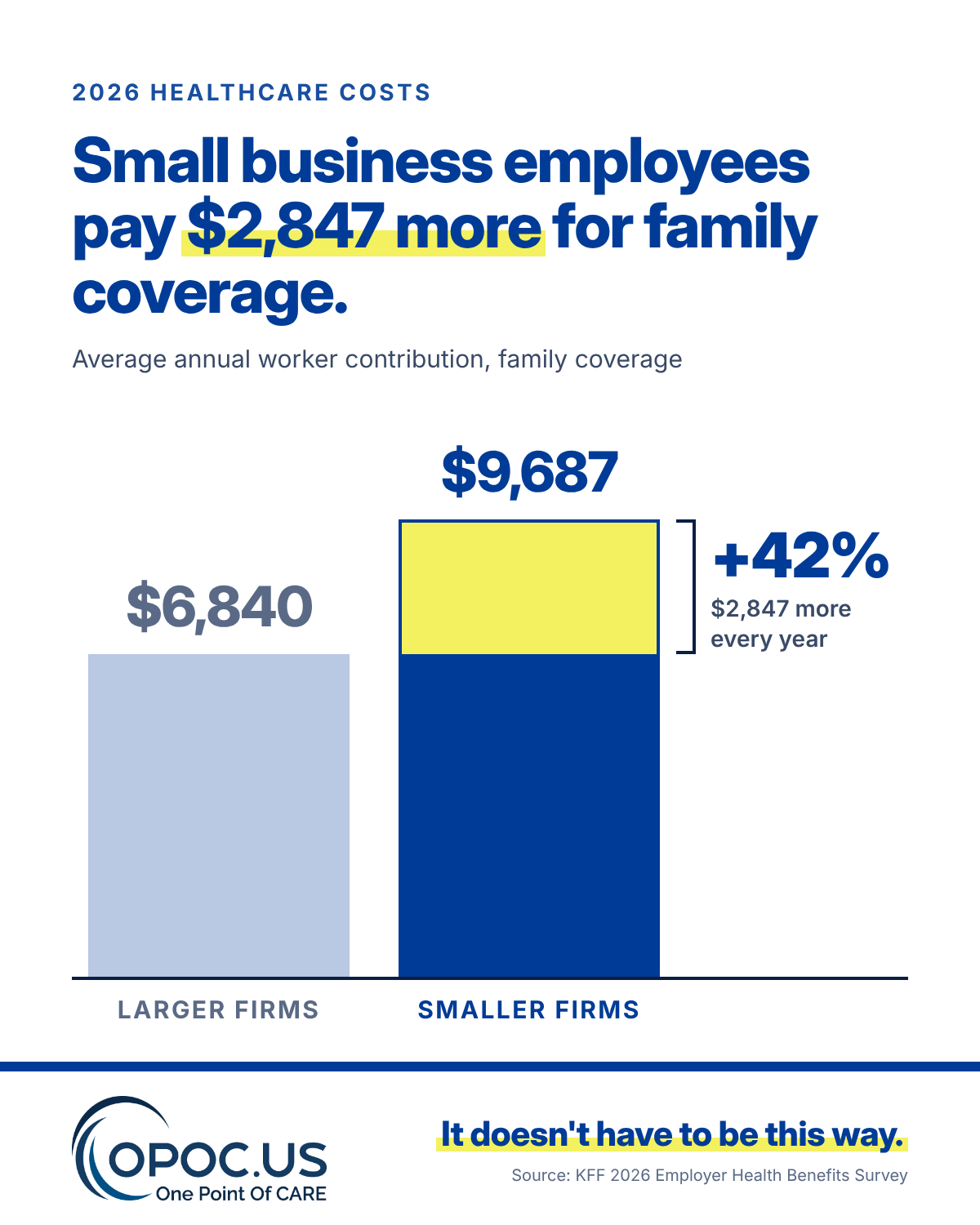
For an employer with 5, 50 or 100 employees, an 11%, 15%, or 18% annual renewal increase is so significant it impacts hiring and salary decisions, and the quality of benefits that can be offered.
Morgan Health found that 30% of businesses with fewer than 50 employees say rising healthcare costs are actively worsening their business situation, compared with 22% of larger SMBs.
Smaller employers generally have less negotiating leverage with carriers, fewer internal benefits resources, and less ability to absorb a six-figure increase without taking money from somewhere else in the business or shifting the costs and impact directly to their employees.
Among SMBs responding to rising healthcare costs:
- 29% implemented wellness or other cost-saving programs
- 20% cut spending elsewhere in the business
- 19% slowed hiring
- 17% shifted additional costs to employees
- 71% have taken at least one cost-management action during the past three years
42% of SMB owners say they are considering cutting health coverage, within the next one to three years.
What’s driving the increase?
Three factors show up consistently across the research:
GLP-1 drugs. Roughly 27 insurers now specifically cite GLP-1 utilization as a material premium driver in rate filings. Some employers and carriers are already restricting or eliminating weight-loss coverage.
Specialty pharmacy costs. High-cost specialty drugs continue to consume a growing share of employer healthcare spending.
Provider prices and utilization. Higher hospital and physician prices are combining with increased utilization as delayed care continues working its way through the healthcare system.
None of these pressures are likely to decrease or disappear anytime soon.
Here’s the part most healthcare cost reporting misses.
Premium increases are the symptom. The more important question is what happens between renewals. Is anyone actively managing the healthcare cost trend throughout the year? Or does the employer wait until renewal, receive another double-digit increase, shop the market, make a few plan changes, and start the process again 12 months later?
That’s the structural problem with the traditional benefits model.
At OPOC, our clients see an average 11% healthcare cost reduction in year one, with near-flat per-employee cost trends sustained over a decade. Not because we found a cheaper plan once. But because cost management and customer CARE is the ongoing job, not an annual event.
Read our case studies to find out how businesses in your industry find savings with OPOC.
Compliance note: Results vary by employer size, demographics, and plan design.