







The Healthcare Budget Line Item You Can't Model
Ask a CFO to forecast next year’s labor costs. They’ll get you a number. Rent, materials, software: same thing. These costs move, but they move predictably enough to plan around.
Then ask them to forecast their healthcare budget.
Most will tell you something like: “We assume 10% to 15% over last year and hope for the best.” That’s an educated guess, not a forecast.
For small and mid-sized businesses, healthcare is often the second or third largest operating expense after payroll. Yet unlike almost every other major cost category, it remains one of the least understood and least controlled.

In this article:
Every major expense category has a management process:
- Labor has workforce planning
- Inventory has demand forecasting
- Capital expenditures have depreciation schedules
- Technology has budgeting and utilization reviews
Healthcare often has a renewal.
Premiums increase. Explanations are vague. Options appear limited. And the number that ultimately lands in the budget is largely determined by someone outside the organization. Healthcare is not inherently uncontrollable but the process most companies use wasn’t built for control.
The Problem Is Accelerating
Healthcare inflation isn’t slowing.
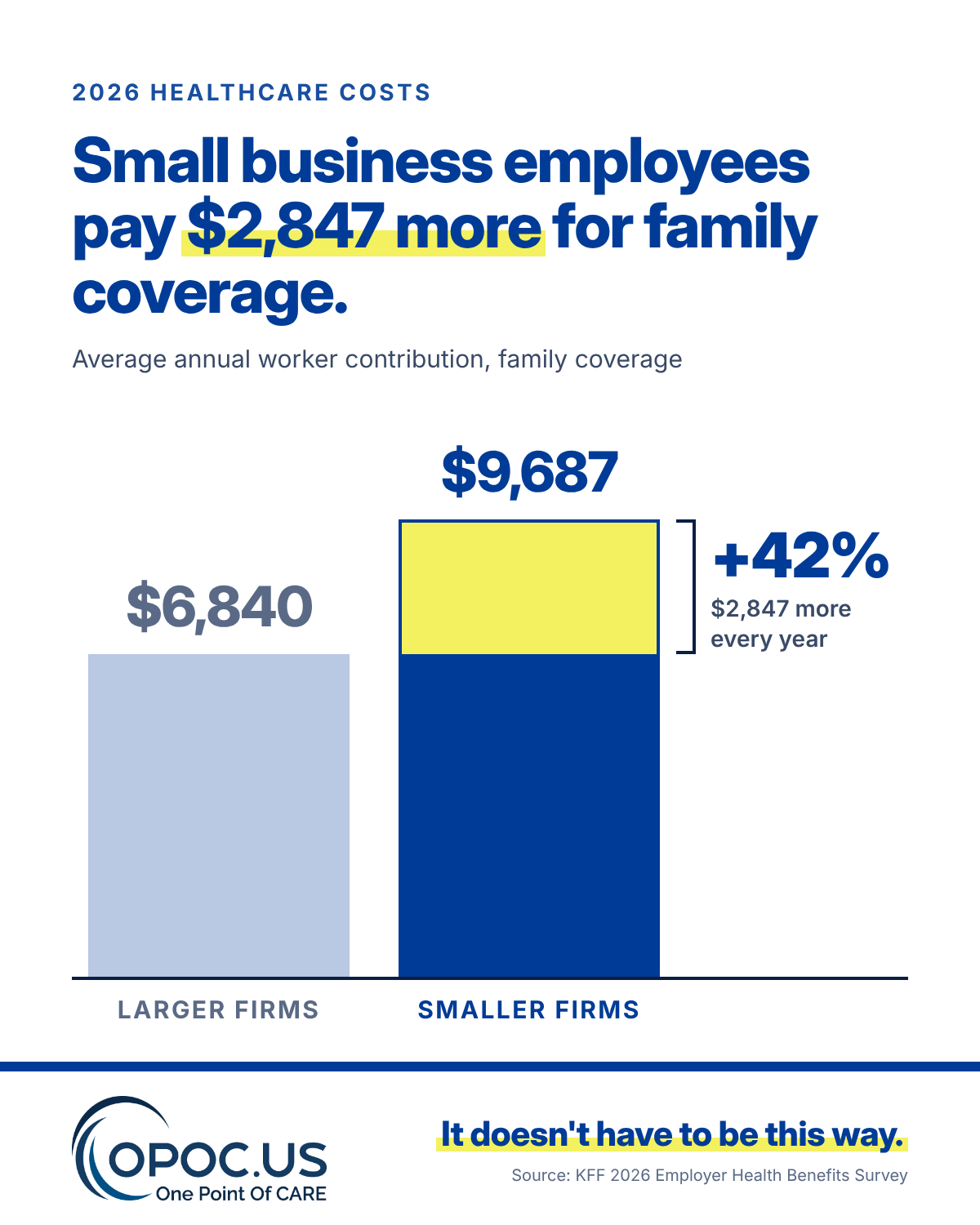
Employers entered 2026 facing some of the highest healthcare cost increases in more than a decade. Rising provider costs, specialty medications, GLP-1 utilization, increased demand for care, and broader economic pressures continue to push healthcare spending upward.
Employer healthcare benefit costs are projected to exceed $18,500 per employee in 2026, with many organizations expecting annual increases of 8% to 10% or more.
For a company with 100 employees, that’s approximately $1.85 million in annual healthcare spend before a single renewal increase arrives.
At a 10% annual trend, that same company could be spending nearly $3 million annually within five years.
For many SMBs, healthcare has become one of the fastest-growing expenses on the income statement and one of the most difficult to forecast accurately.
Why the Forecast Keeps Failing
The annual healthcare renewal cycle is designed around the carrier’s needs, not the SMB’s. Here’s what’s missing from the typical annual renewal request:
- Claims-level cost analysis
- Utilization forecasting
- Strategic plan design review
- Long-term cost modeling
- Ongoing accountability for future outcomes
The result is a cycle many finance leaders know well:
Renewal arrives. Costs increase. Budget adjusts. Nothing fundamentally changes.
The challenge isn’t simply that healthcare costs are rising. The challenge is the variance.
Most CFOs can plan for inflation but they struggle to manage the uncertainty.
Healthcare remains one of the few major operating expenses where organizations routinely accept double-digit cost increases without understanding the underlying drivers.
The Math Gets Expensive Fast
Let’s look at a company with 100 employees.
If healthcare costs average $18,500 per employee in 2026, total annual healthcare spend is approximately:
$1.85 million
If costs continue increasing at 10% annually:
- Year 1: $1.85M
- Year 3: $2.24M
- Year 5: $2.98M
- Year 7: $3.61M
- Year 10: $4.80M
That’s nearly $3 million in additional annual expense without adding a single employee, customer, product line, or facility.
The Structural Problem
Most healthcare advisors are compensated regardless of whether costs improve. Traditional models generally focus on annual renewals rather than long-term cost reduction.
As a result, many employers spend years evaluating plans, changing carriers, and negotiating renewals while seeing little meaningful improvement in their long-term cost trajectory.
Instead of managing renewals, the OPOC approach manages the total healthcare budget. OPOC measures success by long-term per-employee cost performance. That’s a fundamentally different operating model.
What Predictable Healthcare Costs Actually Look Like
OPOC works with SMBs across the U.S., often using a shared savings model built around measurable cost outcomes. OPOC clients’ costs have remained flat per employee healthcare spend on average across a 10-year period, despite the broader market increasing at double-digit rates annually.
Clients also average approximately an 11% reduction in total healthcare spend during their first year while maintaining or improving employee benefits.
The data from our client base tells a different story than the national trend. A few examples:
Midwestern Restaurant Group | 130+ Employees
- Year-one savings: $81,752
- Year-one reduction: 10.4%
- Ten-year cumulative savings: $3.3 million
Regional Waste Management Company | ~64 Employees
- Year-one savings: $153,980
- Year-one reduction: 23.6%
- Ten-year cumulative savings: $3 million
Senior Living Community | ~50 Employees
- Year-one savings: $35,535
- Year-one reduction: 20.7%
- Ten-year cumulative savings: $957,000
These outcomes are driven by a proprietary, repeatable process that includes:
- Detailed claims analysis
- Strategic plan design
- Ongoing cost forecasting
- Carrier and vendor optimization
- Continuous performance monitoring
What a Controllable Healthcare Budget Requires
To move their healthcare budget from reactive to predictable, CFOs need four things that most traditional broker relationships don’t provide:
- Actual data. Not just renewal quotes — real claims analysis, utilization patterns, and cost drivers specific to your employee population. You can’t design a cost-effective plan without knowing what’s driving spend.
- Plan design that matches utilization. Most SMB health plans are generic. Employees often pay high deductibles for services they never use, while the plan doesn’t cover what they actually need. Misalignment between plan design and employee health behavior drives unnecessary cost on both sides.
- Aligned incentives. The best cost-management relationships create accountability for outcomes rather than activity. Success should be measured by long-term financial performance, not annual renewal presentations.
- Ongoing strategic oversight. Healthcare costs require continuous monitoring, not once-a-year monitoring, employee support that reduces unnecessary claims, and proactive adjustments before renewal — not scrambling after the number comes in.
The Forecast Problem Is Solvable
The CFOs who’ve cracked this have started treating healthcare as a managed cost, not an uncontrollable line item, with the same rigor they apply to any other operating expense.
They benchmark against per-employee cost data, understand the incentive structure of their benefits partner, analyze utilization before renewal season, and hold their advisor accountable for outcomes year over year.
The companies in the case studies are saving millions because they changed the model and approached their benefits in a different way. They’re actively managing healthcare spend with the same rigor they apply to labor, technology, procurement, and every other critical cost center.
If your healthcare budget forecast feels like an annual guess, that’s worth examining as a financial operations problem with a structural solution. Contact OPOC to learn more.